
Keeping your labour costs in check

Changes to the wage floor
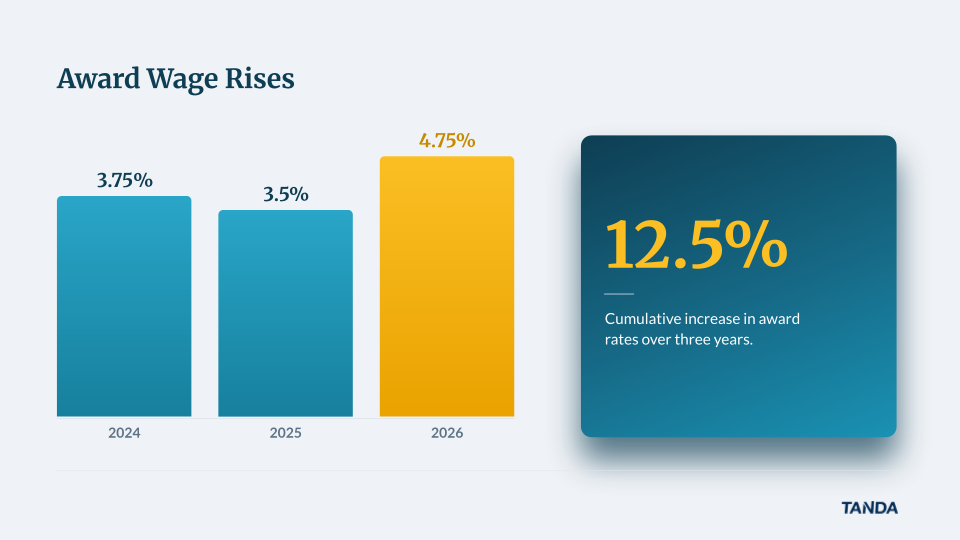
On 1 July 2026, three things changed for many Australian businesses on the same day. Award rates rose 4.75%. The National Minimum Wage crossed $1,000 a week for the first time. And Payday Super started, meaning super is now due every pay run instead of once a quarter.
Stack this year's rise on top of the rises in 2024 and 2025, and award wages have compounded to a cumulative rise of around 12.5% in three years. That's landing on top of input costs that are already elevated, food and energy among them.
On the labour side specifically, Restaurant & Catering Australia's 2025 benchmarking report puts wages plus super at 40.25% of turnover across restaurants, cafes, and catering for FY2024–25, well above the ATO's small business benchmarks from the year before, a sign of how fast this number is actually moving.
We sat down with Tyler Caskey, Partner at TheBeanCounters, and Tanda's Head of Hospitality & Partnerships, Nick Braban, to talk through what's changed and how the operators managing this well are tracking it.
The impact of award rate changes, price rises, and Payday Super
It would be easy to read a 4.75% award increase as a bad-news story for employers.
"This isn't all doom and gloom, margins are still sticking pretty well," Tyler says. "This is a trailing increase as well, a cumulative effect over the past two years that's really catching up."
Price rises have followed, and the market has largely absorbed them.
"I've seen very little resistance to price rises," Tyler says. "When it comes to coffee, my order's a regular latte with an extra shot, and that's gone up well over 20 to 25% over the last three years. Price rises from operators are just a lot more common now."
Nick's seen the same shift in customer expectations. "People are now understanding that it's probably okay to raise prices, and the population does understand the pressure that businesses are under," he said.
There's an upside to the wage rise itself, too, one Tyler's seen play out with his own clients. Higher pay in retail and hospitality keeps staff from leaving for better-paying work elsewhere. "It means we get more people sticking in these retail jobs and hospitality jobs too, because they're not getting priced out to go do something else like nannying at $50 an hour."
One of the other impacts this year is the introduction of Payday Super. Tyler sees it as a cash flow win. "I actually think this is better because it's less of a big hit to cash flow management. The positive is better cash flow management, and it's also much better for the employees. Way better."
Tyler has lived the alternative himself, running a small business on quarterly super payments. "The mental maths that I do each quarter to manage my cash... if people are leveraging their business on having money for a quarter that they've got to pay, it's usually not a profitable one," Tyler says.
Why labour is still the easier lever to pull
When it comes to managing your Profit & Loss, labour is one of the few costs you can actually plan around.
"Award rises go up once a year, ordinarily, at the start of the financial year. With good budgeting and planning, you can set yourself up for another 12 months without that changing," Nick says.
Cost of goods is a different story, where supply chain shocks and energy price volatility can throw a forecast out overnight.
Monthly reporting versus weekly tracking
For most businesses, the numbers only surface at month-end, by which point an unbudgeted week has already happened. Tyler's view, from years as an outsourced CFO across hospitality and retail: "If the data isn't live and doesn't go backwards and forwards, it's one of the hardest parts of the job."
His advice differs depending on the business. "For high-end businesses like law firms and accounting firms, a monthly P&L really makes sense. But in these margin businesses, a daily or weekly P&L can be an absolute game changer. It doesn't need to be rocket science, some businesses just do it in a spreadsheet and send it as a screenshot."
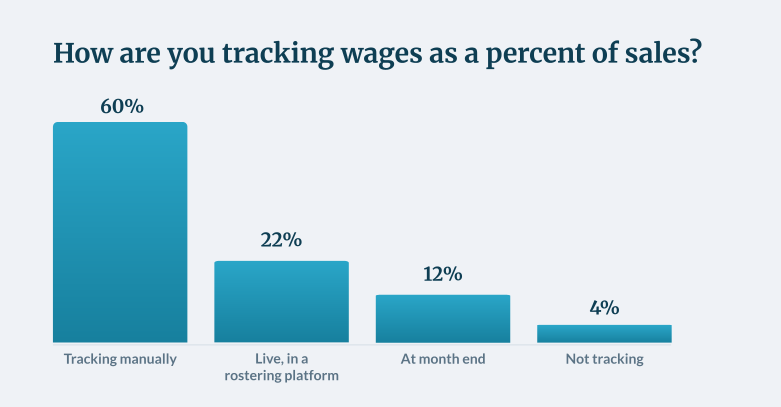
We polled the live webinar audience and got some great insights. Of the 93 who responded, the majority (63%) said their view of labour cost hadn't really changed since 1 July. But when we asked how they're actually tracking wages against sales, only 22% said they were doing it live in their system. 60% are still tracking it manually (weekly or fortnightly), and a further 16% are only checking at month-end reconciliation, or not tracking it at all. Reading this data all together, perhaps most people don't feel like anything's changed, because the tracking itself hasn't caught up to the cost.
The number to track: wages as a percentage of sales
Wages as a percentage of sales is the key metric to track because it moves with the business. A fixed monthly total can't tell you a slow Tuesday just blew the roster budget, but the percentage catches it straight away. Tyler keeps it simple, "If I've got $100 of revenue, how much is wages, how much is COGS, and how much is other? The more you can visualise that, the better."
He's also a fan of breaking it down below the whole-business level. At a recruitment business he ran finance for, splitting P&L reporting by team lead showed one team consistently running lower margins on standard placements, while a specialist team's higher fees supported a materially different cost structure. The same logic applies inside a single venue with multiple concepts, a busy front bar might comfortably run wages at 23%, while a quieter, lower-service area in the same building needs a different benchmark entirely.
Reviewing the benchmark data
Labour cost as a percentage of turnover varies by industry:
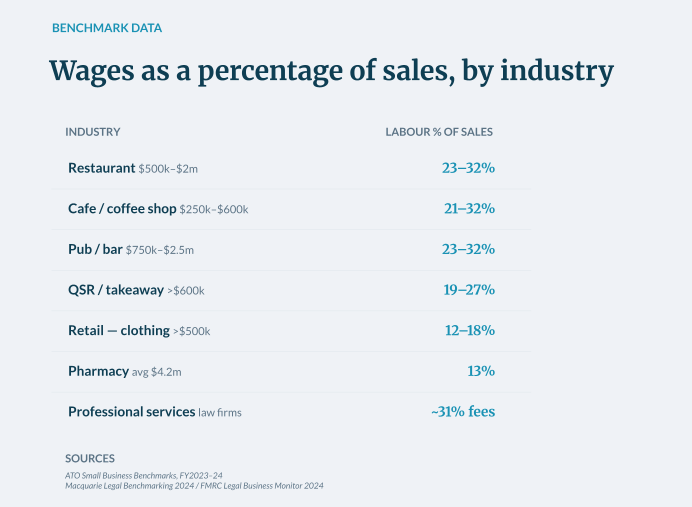
Note: The ATO-sourced figures (restaurant, cafe, pub, QSR, and retail) include wages, contractor, and commission expenses, but not superannuation, payroll tax, or workers' compensation. The pharmacy and professional services figures use different methodologies; published sources don't confirm whether they include on-costs.
How to keep your labour costs in check
Rostering discipline
Build to forecast demand, not simply to habit. That means tying every shift to expected sales rather than what was rostered last time.
Overtime and penalty management
Catch penalty and overtime spend before it lands in the pay run.
Cross-training
Flexible teams cover gaps without always reaching for extra hours. Plus, "Having that cross-training between people means when someone goes on leave, the whole business doesn't stop," Tyler says.
Weekly wage tracking
Review wages against sales every week, not once a month.
Structuring your team for cost efficiency
The casual-versus-permanent question came up during the webinar. Tyler's own view is shaped by running a fully casual team himself.
"I like the ethics of casual work and paying people for what they're worth," says Tyler.
His reasoning is that staff who work variable or long hours are often better served, and paid more fairly, on an hourly rate with overtime than a fixed salary that quietly absorbs unpaid extra hours.
How Tanda supports better cost control
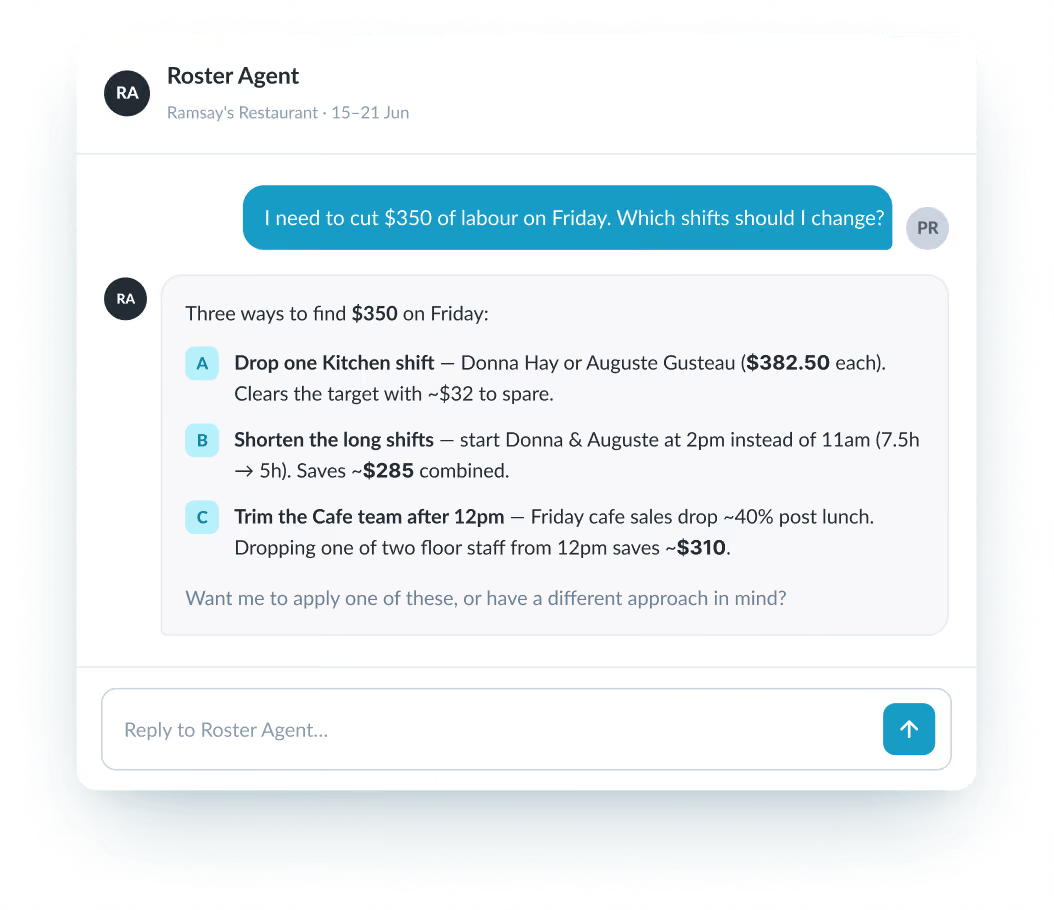
A live demo during the session showed POS data feeding into Tanda every 15 minutes, generating automatic sales forecasts that managers can adjust. From there, wage percentage targets can be set by department or venue, giving managers a live traffic-light view of whether a roster is on budget before it's published. The new AI Rostering Agent takes this further, building a draft roster against demand, staff rules, and budget targets, which a manager reviews and approves rather than builds from scratch.
Additional resources
Frequently asked questions
These questions came from the live audience during the webinar.
Move from monthly to weekly, at minimum. Wages as a percentage of sales is the number to watch, not total wage spend, because it catches drift while there's still time to act on it.
No. The ATO-sourced figures (restaurant, cafe, pub, QSR, and retail) reflect wages, contractor, and commission expenses, not superannuation, payroll tax, or workers' compensation, so real labour cost sits higher than shown for those five. The pharmacy and professional services figures use different methodologies, and published sources don't confirm whether on-costs are included there.
Yes, though the mechanics differ. Retail, professional services, and healthcare all carry their own benchmark ranges and their own award considerations, the principle of tracking wages against sales weekly rather than monthly holds across all of them.
There's no single right answer, it depends on the business and the roles. Staff working long or variable hours are often better served on an hourly rate with overtime than a fixed salary that absorbs extra hours unpaid.
Georgie Pollok
Ready to get started with Tanda?




Keep compliance top of mind with workplace resources
Get the latest tools and articles sent straight to your inbox