
Employing visa workers in Australia: what employers need to know

The information in this article is drawn from a webinar hosted by Tanda in partnership with Thomsons migration lawyer Rebecca Macmillan. Rebecca leads Thomsons' migration law division and works with businesses across a range of industries on visa compliance, sponsorship obligations, and record keeping. The content is general in nature and does not constitute legal or migration advice. For advice specific to your circumstances, contact a qualified migration lawyer.
The current environment
Hospitality and retail businesses have always attracted scrutiny when it comes to migrant worker compliance. There are many well-documented examples of cases involving businesses in Australia where workers were underpaid and the businesses faced court-imposed penalties as a result. The Fair Work Ombudsman secured $179,221 in penalties against operators of two petrol stations in Tasmania alone, after four migrant workers were underpaid $20,230 across two months of work.
What's changed recently is the intensity of enforcement. The Fair Work Ombudsman’s 2025-26 Corporate Plan names vulnerable and migrant workers as an enduring compliance focus, and the agency is now running joint operations with the Australian Taxation Office and the Department of Home Affairs Australian Border Force.
In September 2025, Fair Work Inspectors joined the Australian Border Force for unannounced visits to more than 40 Sydney businesses in a single operation. Late last year, a one-off data exchange matched visa records with payroll data for approximately 58,000 visa holders across three financial years. The two agencies can now cross-reference your payroll against immigration records with relative ease.
If you employ visa workers such as international students, working holiday makers or sponsored workers, this is the environment you’re operating in.
Right To Work checks
Under the Migration Act, every employer in Australia has a legal obligation to ensure their workers have the right to work. And this obligation continues throughout the entire employment relationship.
The Act is specific about what that means.
For Australian and New Zealand citizens, inspecting documents is sufficient. An Australian passport, citizenship certificate with photo ID, or birth certificate with photo ID all qualify. Keep a file note of what was checked, when, and by whom.
For temporary visa holders and permanent residents, a VEVO check is required. VEVO is the Visa Entitlement Verification Online system run by the Department of Home Affairs; it confirms a worker's visa status and conditions directly from the source. Save a copy of the results on file. If you'll need to run re-checks, keep a copy of the passport securely so you're not chasing the employee each time.
The penalties for getting this wrong are not small. Allowing an unlawful non-citizen to work carries a civil penalty of 240 penalty units, currently $79,200. Allowing a lawful non-citizen to work in breach of a work-related condition carries the same. In cases involving exploitation, penalties extend to five years imprisonment or 900 penalty units ($297,000), or both.
Why one check isn't enough
The obligation continues after onboarding. For bridging visa holders, you're required to re-check every three months. If something changes in that period, the fact that you ran the check is your protection, so keep the records.
Other trigger points for a re-check: visa expiry approaching, a role or hours change, a new visa granted, or an employee advising they've lodged a new application.
Remember that no two visas are the same. The most common visa types in hospitality and shift-based work each come with different conditions.
Student visas are generally limited to 48 hours per fortnight while the course is in session. Masters and PhD students may have unlimited rights. Family members of student visa holders have different conditions again — check them separately and don't assume they mirror the primary holder.
Working holiday makers can only work for one employer for a maximum of six months. Exceptions exist, but if you're relying on one, document it. Take a screenshot of the relevant Department of Home Affairs policy page with the date. COVID taught us that policy can change without the legislation changing, and screenshots are the only evidence you'll have.
Employer-sponsored workers on a subclass 482 must work only for their sponsoring employer and only in the occupation for which they were sponsored. For regional visa holders, there's an additional requirement to live, work, and study in a designated regional area, which limits where they can be transferred.
Unlawful non-citizens have no work rights. No exceptions.
The information has to reach the people making decisions
One of the most common ways businesses get caught out isn't a deliberate breach. It's an information gap. HR runs the VEVO check. The results go into a file. The supervisor building next week's roster has no idea the employee is capped at 48 hours a fortnight.
A large hotel client learned this directly. They were reported to the Department of Home Affairs by a competitor for allowing students to work beyond permitted hours. The HR team knew about the restrictions. The supervisors allocating overtime had no idea. The business identified the process failure, implemented new procedures, and provided evidence to the department. The breach was found to be unintentional. Outcome: a warning.
That's a reasonable outcome, but only because the business responded well. The breach was entirely avoidable. Work rights information needs to reach the people making rostering and payroll decisions and not just sit in a file.
What an audit actually looks like
Site visits from the Australian Border Force, or the Fair Work Ombudsman are often unannounced. Inspectors arrive knowing why they're there.
One client received an unannounced ABF visit and was handed a six-page letter before the inspectors left, requesting records and information with 14 days to respond. The checklist ran to four and a half pages. It covered a list of all visa holder employees with names, dates of birth, employment period, and work location, signed employment contracts for sponsored workers, records of all hours worked outside standard hours, bank statements showing salary payments, superannuation and PAYG records, market salary rate evidence, and copies of labour market testing evidence from the original visa application — in some cases, from several years prior.
If your sponsored workers have been with you for a few years, do you still have the documentation from their original nomination?
How to reduce your risk
Most breaches don't come from deliberate misconduct. They’re more likely to come from fragmented processes, poor visibility, and records that aren't built to withstand scrutiny. Here's how you can reduce your risk:
System and software considerations
Workforce management software won't replace legal or migration advice, but it can do a lot of the operational heavy lifting. Tanda integrates with vSure to automate VEVO checks, stores results as employee qualifications, and surfaces visa restrictions in the rostering workflow so a manager building a roster gets a warning before they accidentally schedule a student visa holder beyond their hours cap. Centralised records mean that if an inspector shows up, you can pull what they need quickly.
Additional resources
Keen to learn more?
Frequently asked questions
The content below has been prepared in consultation with Thomsons migration lawyer Rebecca Macmillan. These answers are general in nature and do not constitute legal or migration advice. Seek professional advice for your specific circumstances.
An employee on a student visa occasionally exceeds their hourly cap — what steps should we take?
Stop the excess hours immediately and document what happened. Look at your rostering process to understand how the breach occurred. Was the supervisor unaware of the restriction, or did the system allow it through? Run a VEVO re-check to confirm the current visa conditions and keep records of both the breach and the corrective steps you've taken. If you're concerned about your exposure, seek advice from a migration lawyer. The Department of Home Affairs generally takes a more educative approach where a breach is unintentional and the employer can demonstrate they've identified and fixed the process gap.
How is an employer supposed to know when a student's course is "in session"?
Ask the student to provide a copy of their course schedule at the start of each academic year. Most institutions allow students to print this directly from their student portal. Keep a copy on file. If you're unsure about a specific institution's term dates, you can look them up yourself as a cross-check. This documentation is your evidence that you understood the work rights at the relevant time.
Does completing studies count as "out of session"?
This requires specific advice based on the visa conditions and timing. Generally, once a student completes their course their visa conditions may change, but don't assume. Run a VEVO check as soon as you're aware their course has ended and seek advice if you're unclear on what the check shows.
How does "out of session" time factor into the 48-hour fortnightly cap?
When a student's course is out of session, the 48-hour cap doesn't apply and students can work unlimited hours. This applies even if one week of the fortnight was in session — current policy allows unlimited work during out-of-session periods regardless of whether the fortnight straddles a session boundary.
If a student visa holder moves to a Bridging A Visa, are they still bound by the 48-hour restriction if they're no longer studying?
Bridging visa work conditions vary and depend on the underlying visa application. Don't assume the student visa conditions carry over, or that they disappear. Run a VEVO check when you become aware of the bridging visa and read the conditions carefully. If anything is unclear, seek advice.
We have students whose institution supposedly exists for paperwork only — what can we do?
As an employer, your obligation is to verify work rights. You're not responsible for what the student does with their own visa conditions. So long as your VEVO checks are current and your records show the conditions at the time of rostering, you've met your obligation. If you have genuine concerns about a worker's situation, seek advice on how to handle it appropriately.
Do we need to verify that student visa holders are actively studying, and do we need to keep their Confirmation of Enrolment on file?
There's no strict legal requirement to keep a Confirmation of Enrolment on file. Your obligation under the Migration Act is to verify work rights via VEVO. Keeping a copy of the course schedule and enrolment documentation is good practice, though. It provides evidence that you understood the visa conditions and managed hours accordingly. If you're ever asked to explain how you determined the student was in or out of session, that documentation answers the question.
Do work restrictions on a bridging visa default to those of the former visa?
Not automatically. Bridging visa conditions are set at the time of grant and should be read directly from the VEVO result. Don't assume they mirror the former visa. Run a VEVO check when you become aware an employee is on a bridging visa and note the conditions. This applies to subclass 820 holders as well. Re-check every three months while the bridging visa is in place.
Can a sponsored visa holder work beyond their usual hour restrictions while waiting for a new visa?
This depends on the specific bridging visa conditions. Read the VEVO result carefully. Some bridging visas allow full work rights, others carry restrictions. Don't roster beyond what the VEVO check confirms, and if you're unsure, seek advice before the shift goes out.
What exemptions exist to condition 8547, and who qualifies?
Condition 8547 limits working holiday makers to six months with one employer. Exemptions exist for certain industries and regions, and the Department of Home Affairs publishes these on their website. If you're relying on an exemption, document it carefully. Take a screenshot of the relevant page with the date. As COVID demonstrated, these can be policy-only exemptions that don't appear in legislation, and the department's institutional memory isn't always reliable.
Does the six-month restriction reset with each visa grant?
Yes. The six-month limit applies to each visa grant, including bridging visas. If a working holiday maker's first visa expires, they apply for a second, and a bridging visa is granted while the application is processed, the six-month clock restarts on the bridging visa and again on the second working holiday visa. This matters if you want to retain the same worker across multiple visa grants, provided you manage the transition correctly.
Can you get an extension to the six-month restriction?
Where no automatic exemption applies, an extension request can be submitted through the Department of Home Affairs website.
The request must be submitted before the six-month period expires.
What hours can a sponsored visa holder legally be rostered, and can we convert them from full-time to part-time?
A subclass 482 holder must be employed in the nominated occupation and must receive the agreed market salary rate. Changing from full-time to part-time is a material change to the employment arrangement and may have sponsorship implications, particularly around whether the salary still meets the Core Skills Income Threshold and market salary requirements. Don't make this change without seeking migration advice first. Notification obligations to the Department of Home Affairs may also be triggered.
If a 482 holder takes casual employment elsewhere without disclosing it, what are the implications?
The visa condition requires the worker to work only for their sponsoring employer. If they take employment elsewhere, they are in breach of their visa conditions. As the sponsoring employer, your obligation is to comply with your own sponsorship obligations. The worker's conduct elsewhere is their responsibility. If you become aware of it, seek advice on whether you have any reporting obligations.
When sponsoring a visa holder, does their pay increase on application or on approval?
Generally, salary changes tied to a new nomination take effect on approval of the visa or nomination, not on application. Seek specific advice from your migration lawyer when structuring the arrangement.
Is there a legal requirement specifying how often VEVO checks must be run?
For bridging visa holders, the expectation is a re-check every three months. For other temporary visa holders, re-check before employment, at visa expiry, and at trigger events such as a role change, hours change, or new visa grant. There's no single statutory interval for all visa types. The obligation is to take reasonable steps at reasonable times, and what's reasonable depends on the visa type and the circumstances.
What visa-related documentation do we need to keep on file?
At minimum: a copy of the VEVO check result, a file note of what documents were inspected, when, and by whom, and copies of any documents verified. For sponsored workers, you'll also need employment contracts, records of hours worked, evidence of salary payments, and documentation supporting the original nomination, including labour market testing evidence. Keep these for the duration of employment and beyond. If an ABF inspection request arrives years after a worker's visa was granted, you may be asked to produce original nomination documents.
We're looking at sponsoring for the first time. Where do we start?
Start with a migration lawyer before you do anything else. Becoming a Standard Business Sponsor involves an application to the Department of Home Affairs, and the nomination and visa process has specific requirements around the role, salary, and labour market testing. Once you're an approved sponsor, there are ten ongoing sponsorship obligations to maintain, including notification requirements, salary obligations, and record-keeping. Get advice upfront. The cost of getting it right from the start is considerably less than responding to a show cause letter later.
We're recording visas as qualifications in Tanda but tracking condition 8547 and expiry dates is tricky — any suggestions?
There are a few ways to handle this scenario in Tanda, but the most common way is to create a qualification named something like ‘Visa 8547’. Then, apply the qualification to the working holiday maker’s profile, with the Attained Date set to their employment start date, and the Expiry Date set to six months later when they’ve met their limit with your business.
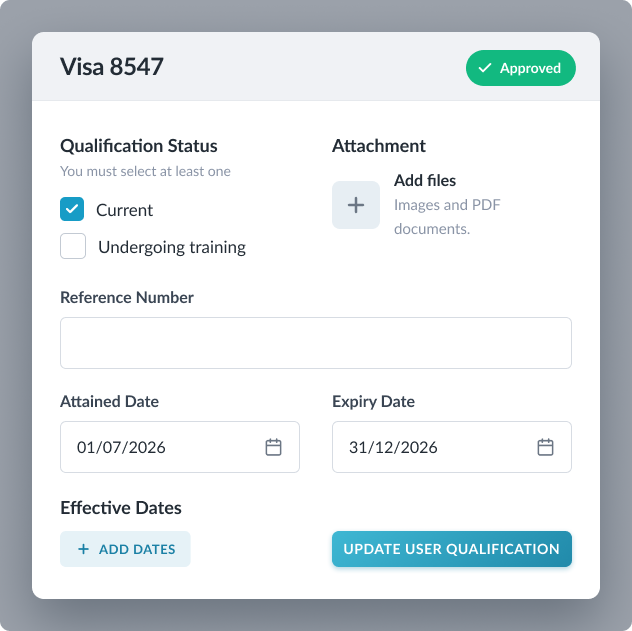
For even stronger visibility and compliance, consider setting up additional settings like:
- Roster validations that prevent staff from being rostered once the expiry date passes
- Employment end dates and automatic deactivation that can be set in advance
- Custom notifications for expiring qualifications either weeks or months out
If you’re juggling multiple working holiday makers, the Employee Qualification report can be run to show any staff with the relevant visa qualification, and filtered to show any that are active, expiring soon (less than one month from expiry), or expired.
What is the process to implement vSure as a current Tanda HR module user?
Access to vSure is included free for all Tanda subscriptions. Setup typically takes around 30 minutes. Once live, vSure sends an SMS to each employee prompting them to provide their work rights documents, runs the VEVO check automatically, and returns the result into Tanda as a qualification, including a PDF copy for your records. Ongoing, vSure runs monthly re-checks for any employees with active visas. Get started with our vSure integration guide.
Georgie Pollok
Ready to get started with Tanda?




Keep compliance top of mind with workplace resources
Get the latest tools and articles sent straight to your inbox