
The pressures facing HR leaders in 2026
The pressures facing HR leaders in 2026
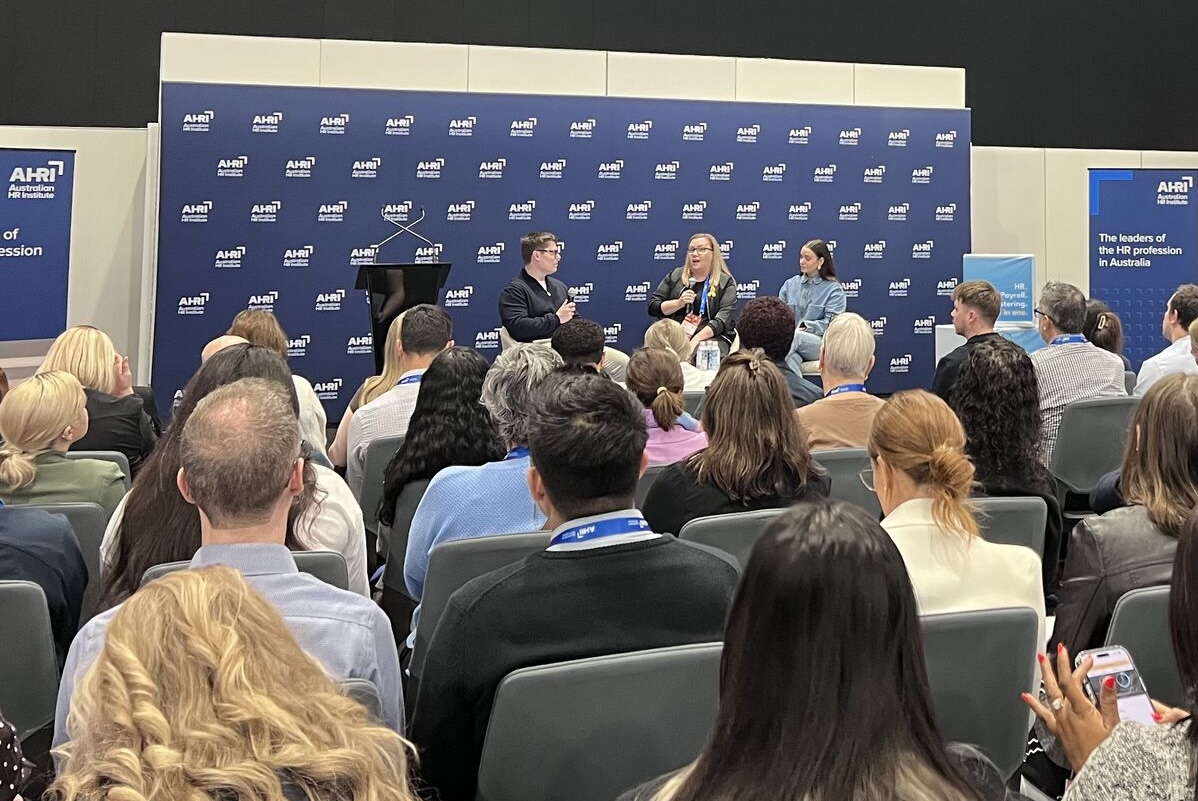
Two senior HR leaders, Brea Corcoran, Head of People and Culture at City Beach Australia, and Rhiannon Howard, Managing Consultant at Industrial HR, sat down with Tanda's Andrew Stirling at AHRI's 2026 National Convention for an honest conversation about what it’s like to be an HR professional. This is HR, off the record.
What’s keeping HR leaders up at night
When Brea Corcoran was asked the question, ‘What’s keeping you up at night?’, she named three things:
- "The first thing would have to be regulatory compliance and reporting across different, parallel bodies of legislation."
- "The second one is definitely the influence of AI on our organisation, and also our industry in general."
- "And lastly, I'd say change management. Leaders are definitely fatigued, and continuing to motivate people through changes that are necessary is a really tough gig."
The house is always on fire somewhere
Rhiannon Howard gets the call when things have already gone wrong.
"The house is on fire; we have a compliance notice from the Fair Work Ombudsman, or we have a number of a myriad of different investigations that need to occur," Howard said.
"The largest type of investigation I'm seeing at the moment is sexual harassment investigations."
Nine times out of ten, the call comes from a HR manager or CEO who is out of capacity, or too worried about getting it wrong to move on their own.
Both panellists described a job that's absorbed more risk than it was ever built to carry.
"I think with every regulatory change that we've seen, there's more requirements for us to know," Howard said. "Workplaces haven't necessarily changed to have subject matter experts in particular areas of HR."
Employees increasingly disclose trauma, mental health crises, and personal safety concerns to HR teams who rarely have the same support structures other professions get for handling that same material.
"HR budgets don't necessarily stretch for everything," she said. "So we choose what we spend, and the rest, us HR people, carry."
Corcoran traced the moment that accountability really landed for her back to COVID, and City Beach's first case. She was the only senior leader in the building that day.
"I will never forget the day that we had our first case at City Beach. That was the day that the penny dropped on that accountability piece," she said.
"You're holding something that you didn't know that you were actually accountable for, and nobody else was going to pick it up... people naturally gravitate toward HR."
You can't really be friends with everyone
One of the more honest exchanges of the session was about the isolation built into the role itself.
"HR sets the rules. You are the ones saying, ‘you can't do this, you can't do that’, then you're the person who gets pulled to come clean that mess up when it does go bad," Corcoran said.
"Initially in my career that did sting a little bit," she said. The discomfort didn't really go away. Corcoran just made peace with it.
"Over time you become okay with that because you realise that's your place sometimes, that you have to be objective, you have to sit outside of those programs."
What helped most, she said, was realising how many other HR leaders felt exactly the same way.
"I think possibly for me personally is that I'm not alone in all of this, and how many other leaders are feeling it too."
The paperwork trail not being kept
Asked what issues she sees repeat across every business she advises, Howard didn't hesitate. It's the slow accumulation of things nobody documented. She gives this common example.
"We've had an issue inside probation and we've continued to employ that person, and then all of a sudden something happens, we've had enough, we've come to a head, and now I get the call: make that person leave by the end of the week, please."
What follows is always the same scramble. "Where's the contract, the policies, the performance reviews, the probation documentation... ? Nine times out of ten they don't have that documentation, or they did have it but don't know where to locate it."
She's also seen the reverse problem: performance records that say the opposite of reality because nobody wanted the harder conversation.
"We have the quarterly check-in records. Great, exceeding, perfect, wonderful, because we didn't want to have that hard conversation with that employee. Or worse, an employee who's been getting bonuses non-stop for the last five years right up until the business decides, suddenly, that the person needs to go."
HR versus the machines
AI is showing up directly in casework, not just in strategy discussions. Howard is seeing it from both directions. Employers now field extraordinarily fast, dense pushback.
"For example, you’ll send a performance interview meeting invitation, and you will get a six-page letter back in ten to fifteen minutes! You're constantly fighting against this AI model who's trying to pick apart everything that you've written."
At the same time, she's watching small and medium business owners try to skip HR altogether by asking ChatGPT directly, only to end up back in her inbox anyway.
"They come to me and they've gone, I think I've made a mistake, and I've gone, well, yes."
"AI is making our job as HR professionals a little bit harder, and also potentially making our job a little bit easier at the same time... it increases the volume in every sense, which can work for you and against you."
Corcoran was more upbeat about it, treating each AI-drafted letter as a chance to sharpen her own thinking.
"It is good to get in the tussle and test yourself out when you do get these things through, just to make sure you were right, and you can flex your own skill by having to respond to something like that."
The changing relationship with staff
City Beach's workforce skews young, and Corcoran was straightforward about what that's changed. The relationship with HR has become far more transactional, cashing out leave, logistics questions, less coming to HR for advice because a chatbot answers first. Asked whether that's a loss, she treated it as simply the new terrain.
"I think it's just a different type of relationship that we just need to accept... AI is not going to stop, the machine is not going to stop, we're continuing on this path."
City Beach's response has been to diversify how they reach people, staying present on the ground in retail locations while also meeting younger staff through channels they're actually comfortable with, like social media and anonymous feedback tools.
What they'd tell someone starting out
Corcoran's advice ran against her own instincts as a graduate.
"When I started my career, I was really interested in the people aspect of human resources... one of my worst subjects at uni was IT," she said.
Nearly a decade later, technology has ended up defining a huge part of her role.
"I'm so surprised how much technology has influenced my career, for a subject that I really hated. My tip is to embrace technology, and do the tech subjects at uni for sure."
Howard's advice was about knowing yourself early. She described asking job candidates directly, "What kind of HR person do you want to be? Where are you going to sit on the spectrum of what we do in HR?" Howard points out that some roles lean hard into IR and discipline, others toward the more relational, people-facing side.
One candidate worked out mid-interview that the ‘harder’ side wasn't for her. "She came back and said, you know what, this really isn't for me, I don't think I can terminate anybody." That kind of self-awareness, Howard said, is a genuine strength.
Where their focus is heading next
Both panellists' priorities for the year ahead centred on the same idea: using technology to buy back time for the parts of the job that actually need a human.
Corcoran said that City Beach has just implemented Tanda, and their focus now is embedding it fully.
For Howard, she’s considering, "How do we capitalise on technology so then we can lean more into the psychosocial safety and the more human element of HR? How do we use the tech to have more time?"
She sees compliance automation specifically as the unlock. "If we capitalise on the ability to automate and monitor compliance... then we do have that time to really go in and be subject matter experts, spend more time with the employees, or spend more time on initiatives for psychological safety, or wellbeing, or culture."
The moment that reminds you why you do it
Asked to close on a moment that reminded them why the job matters, Corcoran told a story about a bulk recruitment round years earlier. A man in his fifties, recently made redundant from an executive role, applied for a basic pick-pack position at a distribution centre, wanting a complete change. "We took a chance on this guy," she said.
Six years on, he's built an entirely different career inside the business, and still stops for a chat every time their paths cross. "Every time I see him, it just reminds me that you actually impact people's lives, even in the smallest way, by giving somebody a job... that for me is a moment that reminds me why we do the things we do."
Brea Corcoran and Rhiannon Howard spoke with Tanda's Andrew Stirling at AHRI's National Convention, 2026.
Georgie Pollok
Ready to get started with Tanda?




Keep compliance top of mind with workplace resources
Get the latest tools and articles sent straight to your inbox